



The Q3 2025 benchmarking report for UK live-in care providers has just been published. Learn how the top 12 UK live-in care providers perform across the digital space.
The latest Q3 2025 benchmarking report for UK live-in care providers has just been published. It covers the largest 12 national live-in care providers, including Home Instead, Bluebird Care, Elder, Consultus Care, Abbots Care, Helping Hands Home Care, Live In Care, Agincare, Right at Home UK, Cera, Trinity Homecare, and The Good Care Group.

The research gives an inside track on who is winning the biggest share of voice online, and quantifies the gaps, risks and missed opportunities for other live-in care providers to win brand exposure locally, improve organic visibility, and generate online enquiries. The report highlights quick wins that will improve enquiries from your online strategy and identifies the barriers that may be reducing your site’s ability to optimise digital performance.
To see a preview and contents page of the Q3 report, click here. To get a copy of the full report and the key takeaways, please complete the enquiry form or schedule a call.
Q3 2025 WINNERS LEADERBOARD
For a glance into just 6 of the metrics, we evaluated these top 12 live-in care providers on, check out our quick-look table below;
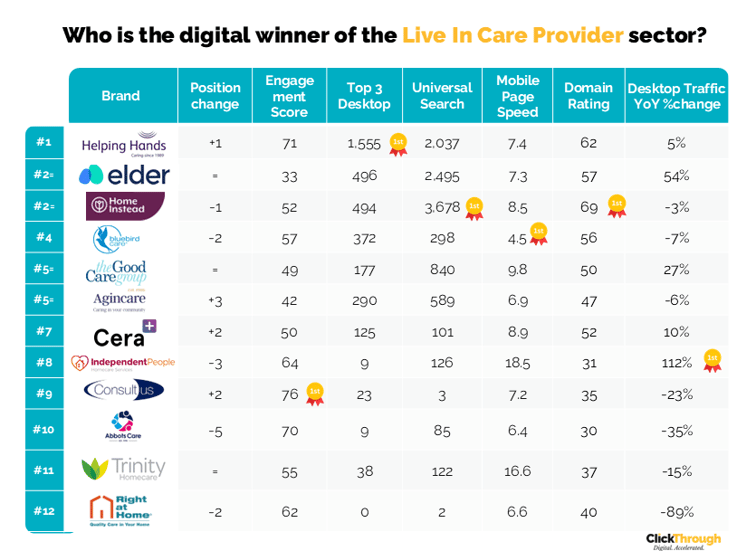
Continue reading for further detail on this quarter's best and poorest-performing UK live-in care providers or request a copy of the report for the full review.
What The Industry Research Report Covers
The 70+ pages of research benchmarks each brand based on 50+ metrics and indicators of successful digital strategy, including organic visibility, domain authority, paid media ads, conversion performance, technical performance, site speed, universal search, content, social ads, accessibility, and mobile performance.
Driving Optimal ROAS from Paid Media Channels
Some of the leading players in the space are high spenders on paid media channels such as Google, Bing & Facebook - but have a poor or sub-optimal conversion improvement strategy. Without an optimised, sophisticated conversion strategy that maximises the conversion rate, the return on investment is unsustainable or will underperform. Scaling spend on paid media is not achievable unless the conversion rate delivers optimal performance in the sector. Some in the space have paid media spend levels from 30k+ per month but dedicate minimal resources and budgets to conversion testing. Given the cost per clicks on ad networks will continue to rise, we recommend spending at least 10% of your paid media budget on ongoing conversion optimisation testing schedules to ensure your paid media ROI maintains long-term viability, competitive advantage, and sustainability.
Pay-Per-Click Marketing
Pay-Per-Click marketing is constantly evolving, with more and more advertisers being forced to hand over a lot of control to Google's algorithms as the push for automation grows ever stronger. There are still key elements of control that we have though, the main one of these being budget which is ultimately something the algorithms can't take from you. That's why being smart with your budget and ad coverage is essential to achieving strong results and bettering what your competitors have to offer.
For Q3 2025, the average monthly budget wastage across these UK live-in care providers was £1,846, with some of the top players in the market spending a considerable amount on areas and audiences unlikely to deliver a return. We can see this in more detail when looking at the average monthly cost per cost-per-click (CPC) amongst advertisers, with the average of this metric being £62 . This highlights how competitive the market is and how important it is to control your budgets effectively.
There are varying monthly ad budgets across the competitors in the report. While this gap highlights the competitive advantage that larger budgets can provide, it's not just about spending more; it’s about spending smarter. By focusing on driving efficiency in campaign management, targeting, and budget allocation, businesses with smaller budgets can still effectively compete with larger players. Investing in data-driven strategies and refining ad performance can help close the gap and maximise the return on every pound spent, enabling growth even in a competitive landscape. Relative to their spend, Agincare reported the lowest monthly cost-per-click (CPC) at £0, and Bluebird Care has the highest at £520.
The report highlights the importance of budget efficiency by comparing monthly ad spend with estimated CPC in relation to your competitors, see who has the highest and lowest CPC. To maximise the effectiveness of your budget, it’s essential to focus on driving CPC down while maintaining or improving campaign performance. In this report, Trinity Homecare has the lowest estimate monthly ad spend at £64, and Elder has the highest at £108,000.
By optimising targeting, refining ad copy, and leveraging data to identify high-converting opportunities, you can ensure every click delivers maximum value. This approach not only stretches your budget further but also boosts your return on ad spend (ROAS), enabling you to achieve stronger results without simply increasing expenditure.
Technical Website Compliance,
Savvy digital marketers know that having a technically sound website is an essential component of a successful fully integrated digital strategy - plus a site capable of maximising conversion performance. For live-in care providers, they'll want to ensure that potential clients and their families can easily get the information they need to feel comfortable in their care decisions. Live-in care providers should therefore be ensuring they have clear pathways to key informational pages, such as locations, fees and funding.
To prevent 404 errors, websites should regularly audit their content and check for broken links. Using tools like Google Search Console or site crawlers helps quickly identify and address issues.
Site Speed & Conversion Rate Performance
When 62% of consumers are less likely to convert if they have a negative mobile site experience, ensuring that your site is quick and easy to load makes a significant improvement on your overall conversion rates. As with ensuring key pages are easy to find, live-in care providers will want to ensure their sites are quick and simple to use, to help potential clients make decisions faster.
In our previous report, Elder received the slowest mobile site speed (16). This quarter, Elder has increased their mobile site speed to 39, no longer making them the provider to watch. This quarter, The Good Care Group received the slowest mobile site speed (19). Websites can increase mobile site speed by compressing images, using a content delivery network (CDN), and minimising unnecessary code. These optimisations help reduce loading times across different devices and networks.
Building Competitive Advantage with Domain Authority
Domain authority is an essential metric for measuring the effectiveness of SEO performance and helps create a reliable overall gauge of how effective your site is at achieving organic traffic, i.e. ‘free’ traffic that isn’t gained through sponsored ads. Live-in care providers can look to improve their domain authority with a comprehensive digital PR strategy, that targets relevant publications (such as local press or partner vendors) to gain authoritative backlinks.
A ‘good’ DA really comes down to how your competitors are performing, however it’s generally considered average between 40 and 50, good between 50 and 60, and excellent above 60. In our last audit, Abbots Care reported the lowest DA (31). This quarter, Abbots Care remains the provider to watch, and they’ve since decreased their DA score to 30. Websites can follow a structured plan to earn backlinks by creating shareable content, reaching out to industry blogs, and offering guest posts. Consistent outreach and relationship building help secure long-term backlink growth, which can help with a DA score.
Organic Performance – Mobile & Desktop
A strong organic performance is strategically important as it ensures your site ranks above competitors for key, transactional keywords. When 93% of your customers won’t go past the first page of Google, your absence or lack of targeting for essential keywords will cost you conversions. Live-in care providers may be impacted by the cost-of-living crisis, as families could be looking to alternative care routes in order to save money. Therefore, our providers could be battling for a smaller pool of organic visitors.
Seven providers reported a decline in organic traffic on desktop, with Right at Home UK receiving the biggest loss (-89%). On mobile, 7 brands reported a decline in organic traffic, with Consultus Care receiving the biggest loss (-99%). Providers can increase organic traffic by optimising for relevant keywords, publishing high-quality content, and ensuring strong on-page SEO. Consistency in updates also helps maintain search engine visibility.
Universal Search Opportunity
Google Universal Search Results is an evolving opportunity to make your pages visible on a SERP (Search Engine Results Page). Universal results often appear before traditional listings and are eye-catching for users. Universal search results refer to rankings on a SERP that are not the traditional ‘blue line’ Google link, and a brand can appear for universal search results without being strong in standard rankings. For live-in care providers, 'local pack', 'reviews' and 'people also ask' will be key opportunities in universal search to grow trust in their service, along with provide more information, directly from the SERP.
Home Instead remains the one to beat for the most Universal Search appearances (3,678). The majority of these appearances came from ‘images’ (3,000).
The Longtail Keyword Opportunity
Longtail keywords are often considered high intent and potentially more likely to convert as a searcher is being more specific. Optimising for longtail keywords also puts your content strategy in a strong position to rank for brand new search terms as they enter Google’s index. For live-in care providers, longtail keywords are an opportunity to rank for more in-depth information that potential clients may have, which can help build much-needed trust from the early consideration stages.
Helping Hands Home Care secured the most longtail keyword appearances for position 3 (1,360), and Elder secured the most appearances for positions 4–10 (3,738). On the other hand, Right at Home UK received the fewest appearances for position 3 (0) and the fewest appearances for positions 4–10 (0). A good strategy is to build content around common questions or niche topics that longtail keywords reflect. This approach not only boosts SEO but also positions the site as an authority in its area.
Facebook Adverts
With the number of Facebook users in the United Kingdom (UK) hitting over 44 million users in 2023, it is not surprising that companies have jumped at the opportunity to advertise on the social media platform. Facebook’s UK digital advertising revenue has been estimated to have breached 2.6b GB pounds in 2019. For live-in care customers, Facebook presents an opportunity to see 'local' relevant content, build brand awareness and a positive image of their service, and even be used to recruit new carers in key areas.
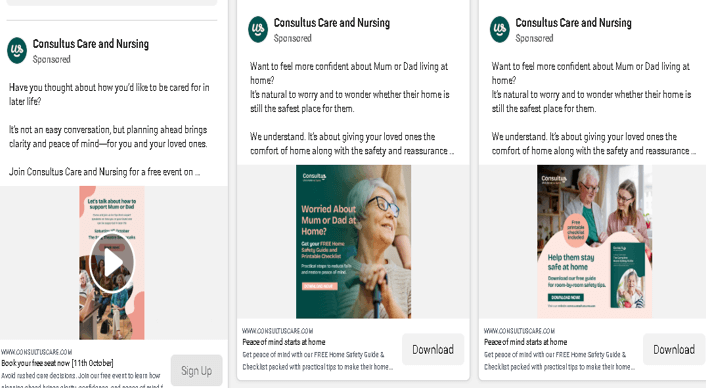
We’ve included screenshots of Consultus Care’s sponsored Facebook posts. While this UK live-in care provider included a question in each post to help with engagement, they should reduce the amount of text per post.
Top Social Shares & Content
When it comes to social media and on-site content strategies, it is important to release content that has a longer shelf life. An article is considered 'Evergreen' if it has maintained its relevancy to an audience for longer. It's great for your brand engagement, but great for Google too, who will recognise content which achieves traffic over a long period of time. Content about life as a client would be both interesting and engaging for live-in care providers to share, and also encourage potential clients and their families to make an enquiry.
Elder secured the most Facebook Likes (60,900), and Bluebird Care secured the most Instagram followers (5,700). Facebook was the most popular social media platforms of all brands. Home Instead received the highest total engagement rate (11,809) and the highest average engagement (72).
Website Readability & Accessibility
20% of people in the UK have a disability – 2 million of which are people living with sight loss. In addition, 1 in 12 men and 1 in 200 women have some degree of colour vision deficiency. When websites are not designed to meet these needs, brands lose customer interest as they turn elsewhere. For live-in care providers, accessibility is particularly important as they must ensure everyone is able to engage with their website.
In our last report, Helping Hands Home Care reported 83 accessibility alerts, and Trinity Homecare reported 83 contrast errors. This quarter, Helping Hands Home Care has increased their accessibility alerts to 85, and Trinity Homecare continues to report 83 contrast errors. Another frequent cause is improper heading structure or missing form labels. Without these elements, assistive technologies cannot interpret or present information effectively.
GET THE FULL 70-PAGE Q3 2025 REPORT
To get a copy of the full report, please complete the enquiry form. If you want to talk to us about accelerating your digital performance, please call us on 01543 410014 or schedule a call with Rory Tarplee.