



The Q4 2026 benchmarking report for English football clubs (group1) has just been published. Learn how 12 of England's top teams perform on the digital pitch.
The latest Q4 2026 benchmarking report for English football clubs has just been published. It covers 12 English football teams including Liverpool Football Club, Manchester City Football Club, Manchester United, Chelsea Football Club, Arsenal F.C., Aston Villa Football Club, Newcastle United Football Club, West Ham United F.C., Tottenham Hotspur Football Club, Everton Football Club, Sheffield United Football Club, and Leeds United.
The research gives an inside track on who is winning the biggest share of voice online, and quantifies the gaps, risks and missed opportunities for each team to drive traffic to their site. Though, with built-in brand loyalty, these teams aren't strictly competing with one another on a digital level, the report highlights quick wins that will improve enquiries from their online strategies and identifies the barriers that may be reducing a site’s ability to optimise digital performance and drive sales to tickets and merchandise.
To see a preview and contents page of the Q4 report, click here. To get a copy of the full report and the key takeaways, please complete the enquiry form or schedule a call. 
Q4 2026 WINNERS LEADERBOARD
For a glance into just six of the metrics we evaluated these 12 English football teams on, check out our quick-look table below;
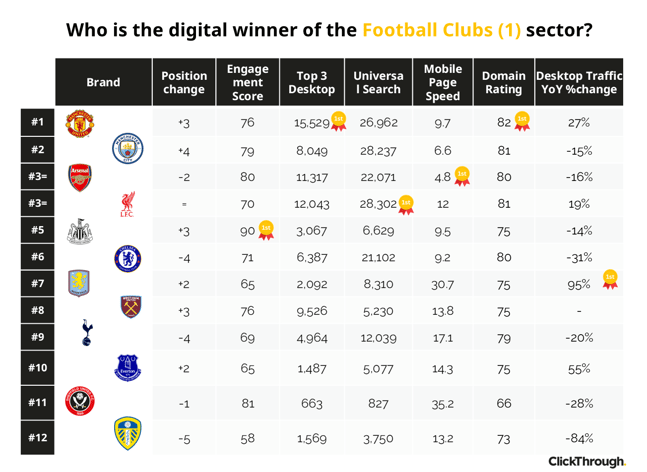
To understand what the *CTM Digital Performance Index™ is click here.
Continue reading for further detail on this quarter's best and poorest-performing English football clubs or request a copy of the report for the full review.
What The Industry Research Report Covers
The 70+ pages of research benchmarks each site based on 50+ metrics and indicators of a successful digital strategy, including organic visibility, domain authority, paid media ads, conversion performance, technical performance, site speed, universal search, content, social ads, accessibility, and mobile performance.
Driving Optimal ROAS from Paid Media Channels
Some of the leading players in the space are high spenders on paid media channels such as Google, Bing and Facebook - but have a poor or sub-optimal conversion improvement strategy. Without an optimised, sophisticated conversion strategy that maximises the conversion rate, the return on investment is unsustainable or will underperform. Scaling spend on paid media is not achievable unless the conversion rate delivers optimal performance in the sector. Some in the space have paid media spend levels from £30k+ per month but dedicate minimal resources and budgets to conversion testing. Given the cost per clicks on ad networks will continue to rise, we recommend spending at least 10% of your paid media budget on ongoing conversion optimisation testing schedules to ensure your paid media ROI maintains long-term viability, competitive advantage, and sustainability.
Pay-Per-Click Marketing
Pay-Per-Click marketing is constantly evolving, with more and more advertisers being forced to hand over a lot of control to Google's algorithms as the push for automation grows ever stronger. There are still key elements of control that we have though, the main one of these being budget which is ultimately something the algorithms can't take from you. That's why being smart with your budget and ad coverage is essential to achieving strong results and bettering what your competitors have to offer.
There are varying monthly ad budgets across the competitors in the report. While this gap highlights the competitive advantage that larger budgets can provide, it's not just about spending more; it’s about spending smarter. By focusing on driving efficiency in campaign management, targeting, and budget allocation, businesses with smaller budgets can still effectively compete with larger players. Investing in data-driven strategies and refining ad performance can help close the gap and maximise the return on every pound spent, enabling growth even in a competitive landscape.
The report highlights the importance of budget efficiency by comparing monthly ad spend with estimated CPC in relation to your competitors, see who has the highest and lowest CPC. To maximise the effectiveness of your budget, it’s essential to focus on driving CPC down while maintaining or improving campaign performance.
By optimising targeting, refining ad copy, and leveraging data to identify high-converting opportunities, you can ensure every click delivers maximum value. This approach not only stretches your budget further but also boosts your return on ad spend (ROAS), enabling you to achieve stronger results without simply increasing expenditure.
Technical Website Compliance
Savvy digital marketers know that having a technically sound website is an essential component of a successful fully integrated digital strategy - plus a site capable of maximising conversion performance. For the football teams in our report, they'll want to ensure key, profit-driving pages such as ticket sales and merchandise stores are easily accessible, and that fans aren't struggling to find what they need by being directed through old or broken links.
When users encounter a 404 error, they may question whether the website is being properly maintained. Broken pages can give the impression that the business doesn't regularly update or monitor its online presence.
Site Speed & Conversion Rate Performance
When 62% of consumers are less likely to convert if they have a negative mobile site experience, ensuring that your site is quick and easy to load will see a significant improvement on your overall conversion rates. English football clubs will want to ensure every touchpoint for their fans is high-performing and provides an excellent user experience - especially if there is frustration elsewhere!
Long loading times can discourage repeat visits. Customers who have previously experienced a slow mobile website may choose not to return, even if they were initially interested in the business.
Building Competitive Advantage with Domain Authority
Domain authority (DA) is an essential metric for measuring the effectiveness of SEO performance, and helps create a reliable overall gauge of how effective your site is at achieving organic traffic, i.e. ‘free’ traffic that isn’t gained through sponsored ads. Football clubs are likely to have high DAs, due to them being long-standing institutions which will naturally gain significant press coverage from highly-reputable sites.
A ‘good’ DA really comes down to how your competitors are performing, however it is generally considered average between 40 and 50, good between 50 and 60, and excellent above 60. A higher domain authority can help websites recover more effectively from fluctuations in search rankings. A well-established website with strong authority often has a solid foundation that supports continued visibility.
Organic Performance – Mobile & Desktop
A strong organic performance is strategically important as it ensures your site ranks above competitors for core, transactional keywords. When 93% of your customers won’t go past the first page of Google, your absence or lack of targeting for essential keywords will cost you conversions. For English football teams, they'll need to ensure their targeted keywords meet their business goals for their site and are optimised in line with any commercial targets that are in place.
Regularly analysing desktop and mobile traffic separately allows brands to identify opportunities for improvement. Understanding how users behave on each device helps businesses optimise content, navigation and performance accordingly.
Universal Search Opportunity
Google Universal Search Results are an evolving opportunity to make your pages visible on a SERP (Search Engine Results Page). Universal results often appear before traditional listings and are eye-catching for users. Universal search results refer to rankings on a SERP that are not the traditional ‘blue line’ Google link, and a site can appear for universal search results without being strong in standard rankings. Football teams can use the 'image pack' search result to highlight their merchandise to fans looking for their store, or 'people also ask' results to quickly answer questions about their stadium or facilities.
The Longtail Keyword Opportunity
Longtail keywords are often considered high intent and potentially more likely to convert as a searcher is being more specific. Optimising for longtail keywords also puts your content strategy in a strong position to rank for new search terms as they enter Google’s index. Longtail keyword opportunities for English football teams can tie nicely into merchandise and ticket sales, including terms such as "Aston Villa season ticket price" or "new Manchester United kit full range".
Longtail keywords help websites attract visitors who are searching for something very specific. Because these search terms are more detailed, they often match the user's intent more closely, increasing the likelihood of attracting relevant traffic that is genuinely interested in the content or services being offered.
Facebook Adverts
With the number of Facebook users in the United Kingdom (UK) hitting over 44 million users in 2023, it is not surprising that companies have jumped at the opportunity to advertise on the social media platform. Facebook’s UK digital advertising revenue has been estimated to have breached 2.6b GB pounds in 2019. Football teams can use paid social advertising to drive awareness of new kits, special fixtures, or featured deals on either merchandise or tickets.
Using vertical images helps brands maximise the available screen space on mobile devices. A larger image can make a post feel more engaging and reduce the likelihood of it being overlooked in a busy news feed.
Top Social Shares & Content
When it comes to social media and on-site content strategies, it is important to release content that has a longer shelf life. An article is considered 'evergreen' if it has maintained its relevancy to an audience for a long period of time. It's great for your engagement, but great for Google too, who will recognise content which achieves traffic over a long period of time. Social media could be especially useful for sharing information about team news, post-match analysis, new kits, and upcoming fixtures.
Website Readability & Accessibility
Around 20% of people in the UK have a disability – 2 million of which are people living with sight loss. In addition, 1 in 12 men and 1 in 200 women have some degree of colour vision deficiency. Football teams will want to ensure they are welcoming to all fans at any point in their customer journey, so should take care to consider accessibility when planning their digital strategy and image.
Poor heading structures can make websites difficult for screen reader users to navigate. Accessibility alerts help identify these problems so content can be organised into a logical hierarchy that is easier to understand.
GET THE FULL 70-PAGE Q4 2026 REPORT
To get a copy of the full report, please complete the enquiry form. If you want to talk to us about accelerating your digital performance, please call us on 01543 410014 or schedule a call with Rory Tarplee.