


The Q3 2026 benchmarking report for UK ceramic brands has just been published. Learn how the top 12 UK ceramic brands perform across the digital space.
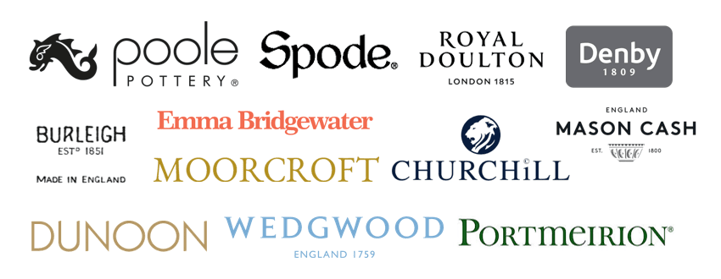
The latest Q3 2026 benchmarking report for UK ceramic brands has just been published. It covers the largest 12 UK ceramic brands, including Emma Bridgewater, Royal Doulton, Denby Pottery Company Ltd, Portmeirion Group Limited, Burleigh (Burgess & Leigh Ltd), Spode, Dunoon Ceramics, Wedgwood, Mason Cash, Moorcroft, Poole Pottery, and Churchill.
The research gives an inside track on who is winning the biggest share of voice online and quantifies the gaps, risks and missed opportunities for other pottery brands to win brand exposure, drive online views, and generate bookings. The report highlights quick wins that will improve enquiries from your online strategy and identifies the barriers that may be reducing your site’s ability to optimise digital performance.
To see a preview and contents page of the Q3 report, click here. To get a copy of the full report and the key takeaways, please complete the enquiry form or schedule a call.
Q3 2026 WINNERS LEADERBOARD
For a glance into just 6 of the metrics we evaluated these top 12 ceramic brands providers on, check out our quick-look table below; 
To understand what the *CTM Digital Performance Index™ is click here.
Continue reading for further detail on this quarter's best and poorest-performing UK ceramics brands or request a copy of the report for the full review.
What The Industry Research Report Covers
The 70+ pages of research benchmarks each retailer based on 50+ metrics and indicators of successful digital strategy, including organic visibility, domain authority, paid media ads, conversion performance, technical performance, site speed, universal search, content, social ads, accessibility, and mobile performance.
Driving Optimal ROAS from Paid Media Channels
Some of the leading players in the space are high spenders on paid media channels such as Google, Bing & Facebook - but have a poor or sub-optimal conversion improvement strategy. Without an optimised, sophisticated conversion strategy that maximises the conversion rate, the return on investment is unsustainable or will underperform. Scaling spend on paid media is not achievable unless the conversion rate delivers optimal performance in the sector. Some in the space have paid media spend levels from 30k+ per month but dedicate minimal resources and budgets to conversion testing. Given the cost per clicks on ad networks will continue to rise, we recommend spending at least 10% of your paid media budget on ongoing conversion optimisation testing schedules to ensure your paid media ROI maintains long-term viability, competitive advantage, and sustainability.
PAY-PER-CLICK MARKETING
Pay-Per-Click marketing is constantly evolving, with more and more advertisers being forced to hand over a lot of control to Google's algorithms as the push for automation grows ever stronger. There are still key elements of control that we have though, the main one of these being budget which is ultimately something the algorithms can't take from you. That's why being smart with your budget and ad coverage is essential to achieving strong results and bettering what your competitors have to offer.
For Q3 2026, the average monthly budget wastage across these UK ceramic brands was £2,179 with some of the top players in the market spending a considerable amount on areas and audiences unlikely to deliver a return. We can see this in more detail when looking at the average monthly cost per cost-per-click (CPC) amongst advertisers, with the average of this metric being £4. This highlights how competitive the market is and how important it is to control your budgets effectively.
There are varying monthly ad budgets across the competitors in the report. While this gap highlights the competitive advantage that larger budgets can provide, it's not just about spending more; it’s about spending smarter. By focusing on driving efficiency in campaign management, targeting, and budget allocation, businesses with smaller budgets can still effectively compete with larger players. Investing in data-driven strategies and refining ad performance can help close the gap and maximise the return on every pound spent, enabling growth even in a competitive landscape. Relative to their spend, Emma Bridgewater reported the lowest monthly cost-per-click (CPC) at £2, and Burleigh (Burgess & Leigh) reported the highest at £18.
The report highlights the importance of budget efficiency by comparing monthly ad spend with estimated CPC in relation to your competitors, see who has the highest and lowest CPC. To maximise the effectiveness of your budget, it’s essential to focus on driving CPC down while maintaining or improving campaign performance. In this report, Burleigh (Burgess & Leigh) has the lowest estimate monthly ad spend at £960, and Emma Bridgewater has the highest at £59,500.
By optimising targeting, refining ad copy, and leveraging data to identify high-converting opportunities, you can ensure every click delivers maximum value. This approach not only stretches your budget further but also boosts your return on ad spend (ROAS), enabling you to achieve stronger results without simply increasing expenditure.
Technical Website Compliance
Savvy digital marketers know that having a technically sound website is an essential component of a successful fully integrated digital strategy - plus a site capable of maximising conversion performance. Having a technically sound website will ensure prospective customers are able to find products they like, obtain the information and specifications about these products, and navigate through pages quickly and efficiently.
In our previous audit, Denby Pottery Company reported the most 404 errors (504). This quarter, Denby Pottery Company has removed all of their 404 errors, demonstrating that they’ve taken into consideration the importance of a website without any deadlinks. Currently, the brand to watch is Wedgwood, with a total of 114 404 errors. Broken pages can discourage users from returning to a website. By minimising these errors, businesses improve the likelihood of repeat visits and long-term customer loyalty.
Site Speed & Conversion Rate Performance
When 62% of consumers are less likely to convert if they have a negative mobile site experience, ensuring that your site is quick and easy to load makes a significant improvement on your overall conversion rates. Given the cost-of-living crisis, consumers are looking for ways to reduce their outgoings, which means cutting down on costs that are considered a ‘luxury’, such as ceramic products. UK ceramic brands should focus on a mobile-friendly design for their mobile website to prevent frustrating consumers.
In our previous audit, Mason Cash reported the slowest mobile site speed (1). This quarter, Mason Cash remains at the bottom of the leaderboard, though they’ve since made improvements to increase their score to 4. Churchill is the brand to beat, scoring 48 for their mobile site speed. A slow mobile site can quickly frustrate customers who expect information to load almost instantly. If pages take too long to appear, many users will leave before they've even had the chance to view the content.
Building Competitive Advantage with Domain Authority
Domain authority is an essential metric for measuring the effectiveness of SEO performance and helps create a reliable overall gauge of how effective your site is at achieving organic traffic, i.e. ‘free’ traffic that isn’t gained through sponsored ads. UK ceramic brands can help to increase their DA score by not just focusing on selling products to consumers but also offering informative, insightful content through blog posts to help increase backlinks.
A ‘good’ DA really comes down to how your competitors are performing, however it is generally considered average between 40 and 50, good between 50 and 60, and excellent above 60. In our previous audit, the brand with the lowest DA score was Poole Pottery (25). This quarter, Poole Pottery remains at the bottom of the leaderboard, scoring 25 still. Improving domain authority encourages website owners to focus on creating useful, informative and original content. High-quality content naturally attracts links and shares, helping to strengthen the website's reputation over time.
Organic Performance – Mobile & Desktop
A strong organic performance is strategically important as it ensures your site ranks above competitors for key, transactional keywords. When 93% of your customers won’t go past the first page of Google, your absence or lack of targeting for essential keywords will cost you conversions. We can expect an fluctuation in organic traffic for both mobile and desktop, given the cost-of-living crisis. All UK ceramic brands can increase their organic traffic by making both their desktop and mobile website formats suitable to the chosen device and adopting a keyword strategy to help increase results in search engines.
Six brands reported a decrease in organic traffic on desktop, with Royal Doulton seeing the biggest loss (-48%). On mobile, four brands reported a decrease in organic traffic, with Churchill seeing the biggest loss (-22%) — an improvement from 39% previously. Search behaviour often varies between desktop and mobile users. People using mobile devices frequently enter shorter or more conversational searches, while desktop users may use longer, more detailed search queries.
Universal Search Opportunity
Google Universal Search Results is an evolving opportunity to make your pages visible on a SERP (Search Engine Results Page). Universal results often appear before traditional listings and are eye-catching for users. Universal search results refer to rankings on a SERP that are not the traditional ‘blue line’ Google link, and a retailer can appear for universal search results without being strong in standard rankings. Customer reviews and images are a great way for UK ceramic brands to increase their Universal Search appearances.
Emma Bridgewater continues to secure the most Universal Search appearances (4,654) — a decrease from 7,792 previously. The majority of their appearances came from ‘images’ (4,300).
The Longtail Keyword Opportunity
Longtail keywords are often considered high intent and potentially more likely to convert as a searcher is being more specific. Optimising for longtail keywords also puts your content strategy in a strong position to rank for retailer new search terms as they enter Google’s index. UK ceramic brands have a wide range of longtail keywords to work with, and should also take the opportunity to look at keywords.
Emma Bridgewater continues to secure the most longtail keyword appearances for position 3 (1,419) — an increase from 1,271 previously. Emma Bridgewater also continues to secure the most appearances for positions 4–10 (2,280) — a decrease from 2,315 previously. Using longtail keywords within page titles and meta descriptions can improve click-through rates when the wording closely matches a user's search query. Relevant search listings are more likely to encourage people to visit the website.
Facebook Adverts
With the number of Facebook users in the United Kingdom (UK) hitting over 44 million users in 2023, it is not surprising that companies have jumped at the opportunity to advertise on the social media platform. Facebook’s UK digital advertising revenue has been estimated to have breached 2.6b GB pounds in 2019. Facebook ads are an effective way for UK ceramic brands to share their latest releases and deals.
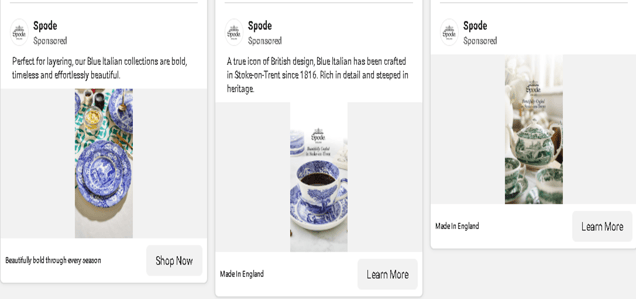
We’ve included screenshots of Spode’s sponsored Facebook posts. Vertical images take up more space in the Facebook mobile feed, making them far more noticeable as users scroll. This increased visibility gives brands a better chance of capturing attention before people move on to the next post.
Top Social Shares & Content
When it comes to social media and on-site content strategies, it is important to release content that has a longer shelf life. An article is considered 'Evergreen' if it has maintained its relevancy to an audience for longer. It's great for your retailer engagement, but great for Google too, who will recognise content which achieves traffic over a long period of time. UK ceramic brands should post content regularly so that followers are constantly in the loop of their products and to also forget people from forgetting about them.
Emma Bridgewater secured the most Facebook Likes (226,500) and the most Instagram followers (533,900).
Website Readability & Accessibility
20% of people in the UK have a disability – 2 million of which are people living with sight loss. In addition, 1 in 12 men and 1 in 200 women have some degree of colour vision deficiency. When websites are not designed to meet these needs, retailers lose customer interest as they turn elsewhere. UK ceramic brands will have universal appeal, so suppliers need to ensure their site is accessible for all. They need to ensure everyone can access and use their website with ease, to stop customers from leaving for a more accessible website.
This quarter, Mason Cash is the brand with the most accessibility alerts, reporting a total of 116. They also flagged the most contrast errors (36). Poor contrast can significantly reduce overall usability, as users may struggle to distinguish buttons, menus, and interactive elements. If key navigation features blend into the background, visitors may find it hard to move around the website. This can lead to confusion and frustration.
GET THE FULL 70-PAGE Q3 2026 REPORT
To get a copy of the full report, please complete the enquiry form. If you want to talk to us about accelerating your digital performance, please call us on 01543 410014 or schedule a call with Rory Tarplee.